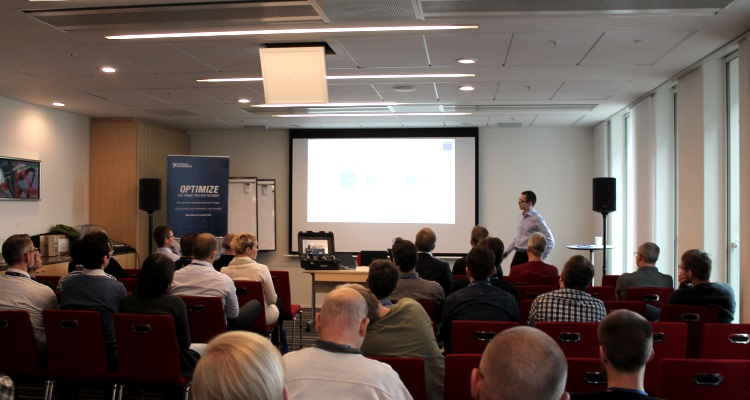
“Building High Precision Instruments with CompactRIO”. That was the headline of one of the presentations at NIDays, delivered by our founder, Steen Secher Schmidt. In the presentation, he helped the audience better understand what it means to build instruments using CompactRIO.
A brief summary of the presentation
Did you miss Steen’s presentation at NIDays in Copenhagen? Below, we have outlined the key points from the presentation:
- What makes instruments custom-built?
- How do we ensure that custom-built instruments can be maintained and expanded with minimal risk and effort?
- What typically goes wrong in this type of project, and how do we avoid these mistakes?
- Are successful projects always synonymous with custom-built instruments?
- Why do we use the GPower Actor Framework instead of the NI Actor Framework?
- How do we combine CompactRIO and LabVIEW?
Why CompactRIO?
When we use CompactRIO, it is, among other things, with the aim of improving advanced control and monitoring systems for everything from sensors and cameras to motors and actuators. In addition, we also use CompactRIO to simplify complex applications, for example when we consolidate a range of subsystems into one unified system, where many different components are connected directly to the instrument.
GPower is a supplier of hardware from National Instruments
When we are able to do this, it is primarily because we define the software in the instrument ourselves. This allows us to customize the instruments as we wish—even after implementation.
![Don’t let your error codes become the next Blue Screen of Death [3:4]](https://gpower.io/wp-content/uploads/2026/09/Figur-1-Windows-11-Blue-Screen-of-Death-1-300x225.webp)

![Error handling in LabVIEW [2:4]](https://gpower.io/wp-content/uploads/2026/06/Fejlhaantering-i-labview-jesper-kjaer-soerensen-gpower-300x169.png)
![Don’t let your error codes become the next Blue Screen of Death [3:4]](https://gpower.io/wp-content/uploads/2026/09/Figur-1-Windows-11-Blue-Screen-of-Death-1.webp)